What Is an Agent Harness?
An oversimplified but useful equation: agent harness ≈ ai agent − model.
Take the model out of an AI agent, and what’s left is the harness: the software that gives the model context, tools, state, permissions, and an environment to act in. A model can reason and generate text. A harness builds on top of that and does work over multiple steps.
A useful way to think about an agent harness is as a loop:
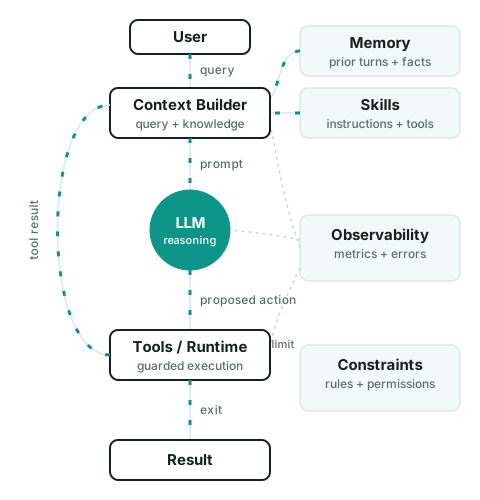
- The harness starts with the current state and a new observation, such as a user message or tool result.
- The context builder selects the instructions, state, memory, skills, tool definitions, and other information the model needs for this step.
- The model produces a proposed next action. This may be a tool call, a message, a state update, or a final answer.
- The harness checks whether that action is allowed.
- The runtime executes it.
- The result becomes a new observation, the state is updated, and the loop continues until exit.
To sum up, The harness decides what the model can see, what actions to execute, what data flows to next step and when to stop the loop.
Further reading
- What is a Harness? — Earendil
- Agent Harness — Microsoft Learn, Agent Framework docs
- The Anatomy of an Agent Harness — Vivek Trivedy, LangChain